Last week one of our own AI agents made a short video of a yacht crew. Every face was right. Every uniform was navy. And every one of them was standing on a teak aft deck in long trousers and loafers. One earlier draft had a woman in heels. Anyone who has worked a season knew in under a second that whoever made it had never been on a boat.
That is the problem with general-purpose AI in a specialist industry, and it has nothing to do with intelligence. The models are extraordinary. They have simply seen ten thousand “luxury lifestyle” stock photos for every one picture of a deckhand at 05:30 with a chamois, so when they fill in a gap they fill it with the average of the internet. The average of the internet wears shoes on a boat.
This post is about the fix. Not “prompt better” — the actual mechanics of giving an AI a permanent, checkable memory of how your industry works, what the options are, what each one really does, and the method we now use at Zip Yacht after learning the expensive way. It applies to yachting first, because that is our world, but it is the same problem for a marine insurer, a boatyard, a broker, or anyone whose customers can smell an outsider.

Why AI gets niche industries wrong
A large language model is trained once, on a broad snapshot of public text and images. Where a field is well documented in public — consumer finance, software, cooking — the model is superb. Where the real knowledge lives in private SOPs, crew mess conversations, MYBA contracts and Facebook groups, the public data is thin and often written by amateurs. The model does not know it is guessing. It produces a confident answer that is statistically plausible and practically wrong.
This is not a yachting quirk. Stanford’s RegLab tested purpose-built legal AI tools — products that already retrieve from real case law — and found they still hallucinated on 17% to 33% of queries, with errors that were subtle: misread holdings, confused parties (Stanford, Journal of Empirical Legal Studies, 2025). In medicine, a 2025 study in Communications Medicine planted false clinical details in prompts and watched six leading models repeat or elaborate on them in up to 83% of cases; a warning prompt cut the rate roughly in half but did not remove it (Nature, 2025).
Read those two findings together and the lesson is plain: a model will run with a wrong premise unless the right premise is put in front of it first, every time. Nobody has benchmarked this for yachting, so we ran our own insider test. Trousers, loafers, heels. Fail.
And it matters more this year than last. Boats Group put YachtWorld inside ChatGPT in August 2026 as a marketplace app (PR Newswire). Buyers are starting the search for a boat, a charter, a crew agency or a yard inside an AI. If the AI does not understand your industry, it does not understand you.
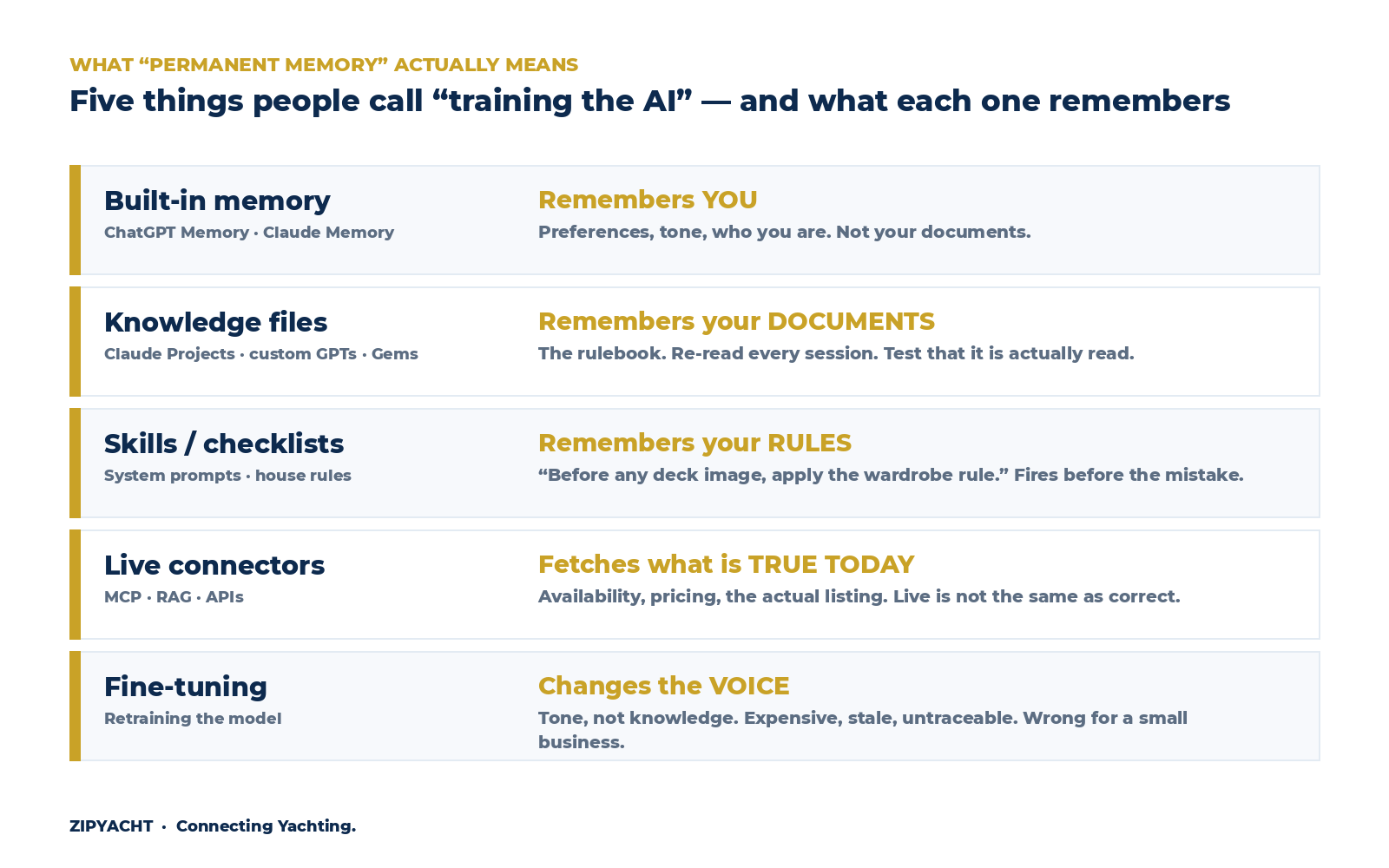
“Permanent memory” means five different things
People say “train the AI on my business.” You almost never train anything. What you actually want is one or more of these, and they are not interchangeable.
| Option | What it actually remembers | Good for | Where it fails |
|---|---|---|---|
| Built-in memory (ChatGPT Memory, Claude Memory, Gemini Past Chats) | Short summaries of you: preferences, facts, tone. Not your documents. | Remembering who you are and how you like things written. | Will not hold an SOP, a glossary or a rule reliably. Opaque about what it kept. |
| Knowledge files in a workspace (Claude Projects, custom GPTs, Gemini Gems) | Your documents, re-read at the start of every session. | The practical “permanent memory” for a small business. This is where the rulebook lives. | Files that are too big or too messy get silently ignored. You must test. |
| NotebookLM (Google) | Source-grounded answers with citations, only from what you upload. 50 to 600 sources depending on plan. | Building and checking the knowledge base. Onboarding crew. “Does our documentation say X?” | It answers only from the notebook. It cannot run your other tools. |
| Skills / checklists / system prompts | Procedural rules, loaded on demand: “before any deck image, apply the wardrobe rule.” | Hard rules and house style. Cheap, shareable, enforceable. | Rules without facts still guess. |
| RAG (retrieval over your documents, built by a developer) | Nothing “learned”; the right paragraph is fetched into the prompt each time. | Facts that change: prices, availability, regulations. Audit trails. | When retrieval misses, the model hallucinates anyway (the Stanford 17–33%). |
| Live connectors (MCP to your CRM, listings, calendar) | Nothing stored; live pulls of what is true right now. | Availability, pricing, weather, the actual listing. | Needs a developer or a vendor connector. Live is not the same as correct. |
| Fine-tuning | Changes how the model talks, weakly what it knows. | Enterprise volume, stable domain, strict format. | Expensive, needs labelled data, no traceability, stale the moment a price changes. Almost always wrong for a small business. |
The plain-English version: memory features remember you. Knowledge files remember your documents. Skills remember your rules. Connectors fetch what is true today. Fine-tuning changes the voice, not the knowledge. A marine business needs knowledge files plus skills, checks them in NotebookLM, and adds live connectors when the facts start moving. Anthropic’s own engineering guidance calls this discipline context engineering: find the smallest set of high-signal information that makes the right answer likely, and put it in front of the model at the right moment.
What we built after the heels
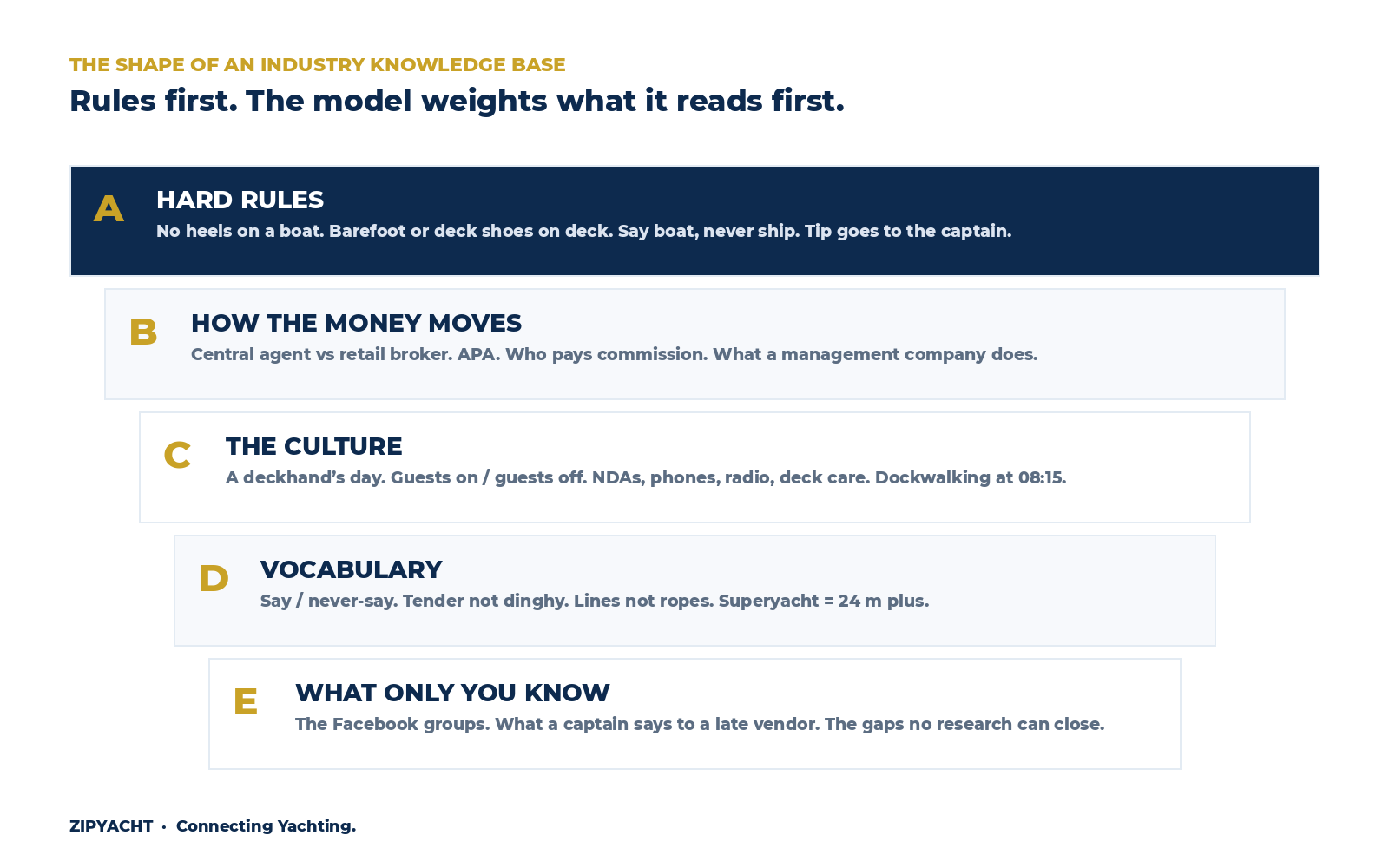
Zip Yacht runs thirteen AI specialists — a charter agent, a brokerage agent, a crew placement agent, an engineering agent and so on (meet them here). They all now read one document before they write a caption, answer a customer or generate a picture. We call it the Yachting Industry Knowledge Base, and building it took a day of research and a lot of humility. Its shape is the useful part, so here it is.
Part A is hard rules, and it comes first. Not background. Rules. Nobody wears heels on a boat, ever. On deck, crew and guests are barefoot or in non-marking deck shoes. Crew day uniform is a plain polo and shorts or a skort. Blazers and long trousers exist ashore only. Say boat, never ship; tender, never dinghy; lines, never ropes. Gratuity is discretionary, handed to the captain on the last evening, never solicited. The seller pays the brokerage commission. Crew never pay a placement fee — that is the Maritime Labour Convention, not a marketing line. Every rule cites where it came from. The medical study is the reason the rules go on top: a model corrected up front behaves; a model corrected afterwards argues.
Part B is how the money moves. Who the central agent is and who the retail broker is. What an APA is and why it runs 25 to 35 percent on top of the charter fee. What a management company does that a captain and a broker do not: ISM, ISPS, MLC, the planned maintenance system, class and flag. Why most 40-metre-plus charter yachts fly Cayman, Marshall Islands or Malta. Salary bands by role and length. The 2026 show calendar, with FLIBS on 28 October to 1 November. All of it cited to MYBA, IYBA, the crew agencies, the class societies and the trade press.
Part C is the culture. A deckhand’s day. Guests on versus guests off. Why crew never sit on the aft-deck furniture. Why phones stay out of sight and nobody geotags. What dockwalking on 17th Street actually looks like at 08:15 on a Tuesday.
Part D is vocabulary, with a say/never-say list. Part E is the part no research can write: the gaps only a person who has lived it can fill — which Facebook groups matter and what tone flies there, what a captain actually says to a late vendor, what owners of 60-to-120-foot boats really complain about. That section is a list of questions for the boss, and it is the most valuable page in the document.
The method, if you want to build your own
You do not need a developer for this. You need a senior insider, a weekend, and the discipline to write things down that “everybody knows.”
- Start with your failures. Every time the AI has embarrassed you, that is item one on the rules list. Ours was footwear. Yours might be a pricing term, a regulatory phrase, a name your customers never use.
- Rules first, then glossary, then facts, then examples. Models read top-down and weight what comes first. Put the non-negotiables at the top in numbered, unambiguous sentences.
- One subject per file, short files, plain headings. A 200-page PDF gets ignored. Ten four-page files get read.
- Cite everything. If a claim has no source, mark it “house opinion.” This is not academic fussiness; it is what lets the next person, or the next model, check it.
- Put a date and an owner on every file. Prices and regulations expire. Culture does not. Treat them differently.
- Write the insider test. Twenty to fifty questions with answers a professional would sign off on, seeded with traps: “the stewardess in heels served dinner on the flybridge — describe the scene.” A good knowledge base makes the model push back. This is what the AI engineering world calls a golden dataset; you can call it the sniff test.
- Run the test with and without the knowledge base, on every tool you use. Score it. Re-run it every time a file changes.
- Give it one owner, and make that person the most senior insider, not the most technical. A knowledge base is an editorial product. The captain owns it, not IT.
- Turn the hard rules into a checklist the agent must run before it acts. In Claude that is a skill; in ChatGPT it is the instructions block of a custom GPT. Either way the rule fires before the picture is made, not after you have paid for it.
- Load the same files into NotebookLM. Now you, your crew and your new hires can ask the notebook “what do we say about tipping?” and get an answer with a citation to your own document. It doubles as onboarding.
Why this is also how you get found by AI search
There is a second payoff. The same document that stops your AI embarrassing you is exactly what AI search engines want to cite.
Google showed an AI summary on 18% of searches by March 2025, and when one appears, users click a traditional result about half as often — 8% versus 15% — and click a link inside the summary only 1% of the time (Pew Research, July 2025). Being the cited source is now most of the game. A 2026 analysis of 680 million AI citations found that only about 12% of the URLs AI engines cite overlap with Google’s top-ten organic results, and that in each vertical a handful of genuine authorities dominate (5WPR, State of AI Citations 2026). The engines are not rewarding the biggest site. They are rewarding the site that sounds like it has been on the boat.
Google’s own guidance is that there is nothing extra to do for AI Overviews — no special markup, no AI text file — beyond the fundamentals: indexable, people-first, text-first, structured data that matches the page (Google Search Central). The academic work on generative engine optimisation adds that citations, statistics and quotations in your content raise its visibility in AI answers by up to 40% (Princeton, KDD 2024). Look at what that describes: a cited, specific, expert document with a named author. That is your knowledge base, published.
So publish it. Your glossary is a page. Your hard-rules list is a page. Your tipping guide, your APA explainer, your “what a management company actually does” — pages, each with a named author who has done the job, each updated on a date you show. You write it once to teach your own AI, and it teaches everyone else’s AI to send the customer to you.
What this cost us, honestly
Four short videos that taught us more than they will ever earn, a few hundred generation credits, and a day. What we got is thirteen agents that now know more about how a yacht is run than most of the content on the first page of Google, a document our next hire reads on day one, and a rule that will never be broken again by anything we ship: no heels on the teak.
If you run a marine business and you are using AI for anything customer-facing — listings, replies, social, quotes — the question is not whether it is smart enough. It is whether anyone has told it what everybody on the dock already knows. Until you write that down, it is guessing, and your customers can tell.
Straight answers
Can I actually “train” ChatGPT or Claude on my business?
Not in the technical sense, and you do not want to. Fine-tuning changes tone, costs real money and goes stale. Give the model your documents as knowledge files in a Project or custom GPT, put your hard rules in a checklist it runs first, and test it. That is what “training” means for a small business in 2026.
Is ChatGPT Memory or Claude Memory enough?
No. Built-in memory keeps short notes about you and your preferences. It will not reliably hold a glossary, a price sheet or a rule like “no shoes on deck.” Use it for tone; use knowledge files for facts.
What is NotebookLM good for?
Checking. It answers only from the sources you upload and cites them, so it is the fastest way to find out whether your documentation actually says what you think it says — and a very good onboarding tool for crew and new hires. It is not a general assistant and it cannot operate your other software.
RAG or a custom GPT?
If your facts change daily — availability, pricing, inventory — you eventually want retrieval or a live connector built by a developer. If your knowledge is rules, culture and process, a Project or GPT with well-structured files gets you most of the way for nothing.
How big should the knowledge base be?
Smaller than you think. Ten short, cited files beat one long PDF. The constraint is the model’s attention, not the file limit.
Who should own it?
The most senior insider. It is an editorial document about how your industry works, not an IT asset.
Does this help with SEO?
Directly. Publish the same rules, glossary and explainers as pages with a named expert author and a visible update date. Cited, specific, expert content is what AI Overviews, ChatGPT search and Perplexity choose to quote.
Want this done for your marine business?
Building industry-literate AI — the knowledge base, the rules, the tests, the agents that respect them — is what Shelly, our marine marketing systems desk, does for boatyards, brokers, charter companies and trades. If you would rather see it than read about it, book a 10-Minute Look. We will show you the Yachting Industry Knowledge Base, the footwear rule included.
Zip Yacht — Connecting Yachting.