
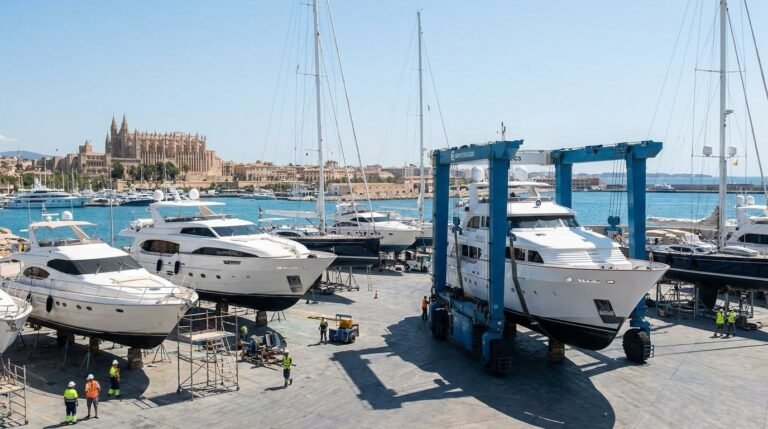
All Shipyards & Haul-out in Balearic Islands
Yacht haul out is the process of lifting a vessel out of the water for work on the hull, running gear and underwater fittings. This page lists shipyards, boatyards and haul-out facilities worldwide, with the lifting capacity, draft limits and yard services that determine whether a yard can actually take your boat. Every listing can be contacted directly.
Choosing a yard is mostly a matter of physical constraints. Get the lift capacity, the beam limit, the draft over the sill and the air draft right first, and only then compare price and availability. A yard that cannot physically take the vessel is not a cheaper option, and the wrong lift type can cost you a season.
How yachts are lifted, and what each method suits
| Method | Typical capacity | Best for | Main limitation |
|---|---|---|---|
| Travel lift / hoist | 15 to 1,000+ tonnes | Most motor and sailing yachts; fast in and out | Slings must clear running gear and stabiliser fins |
| Dry dock | Effectively unlimited | Large yachts, structural work, long yard periods | Availability and cost; scheduled far ahead |
| Marine railway / slipway | Varies widely; often heavy displacement | Long-keel and classic vessels, traditional yards | Fewer yards operate them; slower turnaround |
| Syncrolift / ship lift | Several hundred to several thousand tonnes | Large yachts where dry dock is unavailable | Concentrated in commercial yards |
| Dry stack / forklift | Up to roughly 15 tonnes | Tenders, sportfish and small motor yachts | Size-limited; not for keeled sailing yachts |
| Careening / tidal grid | Small craft only | Emergency and remote-location work | Tide-dependent; limited scope of work |
What gets done during a haul out
A routine haul out covers pressure washing, antifoul preparation and application, anode replacement, and inspection of the running gear, seacocks and skin fittings. This is the annual or biennial cycle most yachts run on.
A longer yard period adds propeller and shaft work, rudder bearings, stabiliser fin service, osmosis treatment or hull fairing, topside paint, and any class or insurance survey requiring the vessel out of the water. Once the boat is ashore, the marginal cost of doing adjacent work is far lower than hauling twice.
The practical rule: plan the scope before booking the lift. Yards charge for the lift, the pressure wash, and then for hardstanding by the day or week. Work discovered after the boat is blocked is what turns a two-week haul out into a two-month one.
How to choose a yard for haul out
- Confirm the physical limits in writing. Lift capacity in tonnes, maximum beam, maximum draft at the lift well, and air draft if there is a bridge or crane on the approach. Ask for the numbers, not reassurance.
- Ask how they sling your specific hull. Stabiliser fins, bulbous bows, prop pockets and long keels all constrain sling placement. A yard that has lifted your model before is worth a premium.
- Check what you may do yourself. Some yards allow owner and crew labour, some allow outside contractors for a fee, and some insist all work is done in-house. This single policy often matters more to the final bill than the day rate.
- Ask about environmental containment. Yards permitted for wet sanding, blasting and paint spraying are a smaller set than yards permitted for antifoul alone. If your scope includes topside paint, confirm the yard can legally do it.
- Understand the full price structure. Lift in, pressure wash, blocking, hardstanding per day, power and water, lift out, and launch. Compare on the total for your planned duration, not on the lift charge.
- Check insurance requirements. Most yards require proof of cover and many require a specific liability level for the period ashore. Sort this before arrival, not on the day.
- Confirm crew access and living arrangements. Whether anyone may live aboard while ashore varies by yard and by jurisdiction, and it changes the cost of a long yard period considerably.
Red flags: a yard that will not give lift capacity and draft limits in writing; no clear hardstanding day rate; vague answers on outside contractor policy; and any yard that quotes a haul out without asking your beam and draft.
Where to haul out
The major refit and haul-out clusters are the northern Mediterranean – La Ciotat, Genoa, Viareggio, Barcelona, Palma and Antibes – which hold most of the large-capacity European lifting; the Netherlands and Germany for structural and heavy work; the United Kingdom for classic and sailing vessels; Fort Lauderdale, Savannah and the US East Coast for the American market; and the Caribbean for winter-season work, though capacity there is smaller and books out early.
Season matters as much as geography. Mediterranean yards are busiest in autumn as boats come out after the summer, and Caribbean yards fill before hurricane season. Booking a lift eight to twelve weeks ahead is normal in a busy cluster, and longer if you need a specific dry dock.
Frequently Asked Questions
Q: What is a yacht haul out?
A: Lifting a vessel out of the water so work can be done on the hull, running gear and underwater fittings. It covers everything from a routine antifoul to a full structural refit, and the method used depends on the vessel’s weight, beam and draft.
Q: How much does a yacht haul out cost?
A: It is normally priced per metre or per tonne for the lift itself, then separately for pressure wash, blocking and hardstanding per day. The lift is rarely the expensive part on anything but the shortest visit – hardstanding time and the work itself dominate the bill.
Q: How often should a yacht be hauled out?
A: Most yachts haul annually or every other year for antifoul and anode replacement, driven by antifoul life, water temperature and how much the vessel is used. Warm water and low usage both shorten the interval, because growth is faster and there is less scrubbing from movement.
Q: How long does a haul out take?
A: A routine antifoul and anode job is typically three to seven days ashore. Propeller, shaft or rudder work adds one to three weeks. Osmosis treatment, hull fairing or a full paint job runs several weeks to several months, largely because of cure and weather windows.
Q: What is the difference between a travel lift and a dry dock?
A: A travel lift carries the vessel in slings to a hardstanding area, which is fast and suits most yachts. A dry dock floods, admits the vessel, then pumps out, leaving her sitting on blocks – slower and more expensive, but it has effectively no weight limit and suits large vessels and structural work.
Q: Can a yacht with stabilisers be hauled on a travel lift?
A: Yes, but sling placement has to avoid the fins, and the yard needs to know their position before the boat arrives. Send a docking plan in advance. This is the single most common cause of damage during lifting, and it is entirely preventable.
Q: Can crew live aboard while the yacht is ashore?
A: It varies by yard and by local regulation. Some permit it with restrictions on facilities, others prohibit it outright. Confirm before booking, because accommodation for a full crew over a long yard period is a significant unbudgeted cost.
Q: Can I use my own contractors in the yard?
A: Depends entirely on the yard. Some are open yards where any contractor may work for a fee; others are closed and require all work in-house. Ask before booking – it frequently makes more difference to the total than the daily rate does.
Q: How far ahead should a haul out be booked?
A: Eight to twelve weeks in a busy cluster during peak season, and considerably longer for a specific dry dock or a large-capacity lift. Off-season and smaller yards can often take a boat at a few weeks’ notice.
Q: What should be prepared before arriving at the yard?
A: A docking plan showing sling positions and underwater appendages, proof of insurance to the yard’s required level, an agreed written scope, and a decision on who is doing the work. Turning up without a docking plan is how boats get damaged in the slings.
Get quotes from shipyards and haul-out facilities
Planning a haul out? Send two or three yards from this list the same details – length, beam, draft, displacement and planned scope – and compare their total for your planned duration ashore, not their lift charge. Ask each one about outside contractor policy before you compare anything else.
Tell us about your yard period and we will point you to the facilities on this list that can take your vessel. Run a shipyard or boatyard? Add your listing.
Related contractor categories
- Refit project management – independent oversight for a significant yard period
- Paint & coatings – antifoul, topsides and fairing
- Fibreglass & gelcoat – composite repair and osmosis treatment
- Mechanical & engines – shafts, propellers and running gear
- Stabilizers & thrusters – fin and thruster service while ashore
- Marine surveyors – out-of-water condition and insurance surveys
- Diving & hull cleaning – in-water alternative between haul outs
Budgeting the wider cost of ownership? See our guide to yacht management cost.
What will the yard period cost?
We publish the real numbers rather than ranges: lift rates per foot, lay days, blocking, cradle hire, containment surcharges and hurricane-season storage, all taken from named yards’ own published rate cards in Florida, the Caribbean, the Mediterranean and the UK. See Yacht Haul Out Cost (2026): what a yard period really bills.
Browse contractors by trade


Browse by area
Owner and crew guides
Independent cost and hiring guides from the ZipYacht team.