
All Refit & Project Management in United States
Yacht refit project management is the discipline of running an owner’s yard period end to end: defining the scope, building the budget and schedule, tendering and vetting contractors, managing the shipyard relationship, and controlling quality and cost through to delivery. A refit project manager is the owner’s representative — the one person on the project whose only client is the owner.
On a large refit they coordinate naval architects, class and flag surveyors, and dozens of subcontractors at once. The role exists to prevent the four classic refit failures: scope creep, blown budgets, missed delivery dates, and uncoordinated trades working at cross purposes. Every company listed on this page works as an independent refit project manager or owner’s representative, and every listing can be contacted directly — there is no commission layer between you and them.
What a yacht refit project manager actually does
A good manager writes a detailed, itemised specification before anyone quotes, so tenders are comparable and change orders stay visible. They run competitive tenders across multiple yards rather than letting one yard price its own scope. They set a contingency at the outset and price every change order before work proceeds. They plan the critical path across trades so the paint booth is not waiting on an electrician. And they inspect work against the specification before it is accepted and paid for.
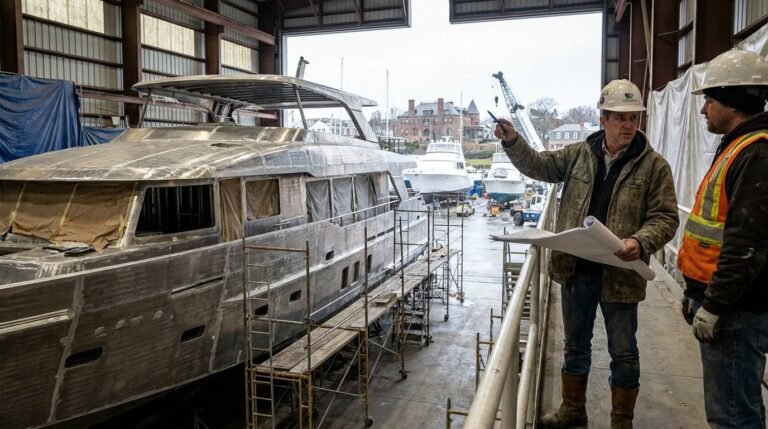
The work divides into four phases. Planning converts the owner’s wish list into a costed, itemised specification and a realistic programme. Tender puts that specification out to several yards and normalises the returns so they can be compared like for like. Execution is daily site management: progress meetings, quality inspection, change-order control, and long-lead procurement. Delivery covers snagging, sea trials, class and flag sign-off, and the warranty period that follows.
How to choose a yacht refit project manager
Most owners choose on reputation and regret it. These are the checks that actually predict a good outcome:
- Comparable projects, not years in the industry. Ask for refits matched by tonnage, systems complexity and yard — a manager who has run three 45m paint-and-systems refits is worth more than one with twenty years of 20m work.
- Owner references, not yard references. Yards recommend managers who are easy for yards to work with. That is not the same as good for you.
- Genuine independence from the shipyard. Confirm in writing that the manager takes no commission, kickback or retainer from the yard or any subcontractor. A manager paid by both sides cannot represent you when the two conflict.
- Technical breadth across hull, systems and interior. Refits fail at the interfaces. A manager who is strong on engineering but cannot read an interior joinery drawing will lose control of half the project.
- A written specification before any yard is approached. If the proposed process starts with “let’s get some quotes,” the tender will not be comparable and the change orders will not be controllable.
- Named site presence. Ask who is physically at the yard, how often, and what happens when they are on another project. Remote management of an active refit does not work.
Red flags: a fee quoted as a percentage with no cap and no scope definition; reluctance to disclose commercial relationships with yards; a schedule with no critical path; no contingency line in the budget; and any manager who presents a single yard rather than a tender.
Independent manager, yard-appointed manager, or self-managed
| Independent refit PM | Yard-appointed PM | Owner or captain self-manages | |
|---|---|---|---|
| Whose interests are represented | The owner’s, exclusively | The yard’s, ultimately | The owner’s, but part-time |
| Typical cost | Percentage of project value or day rate | Bundled into the yard quote — rarely itemised | No direct fee; large opportunity cost |
| Tender across multiple yards | Yes — standard practice | No | Rarely, and rarely normalised |
| Change-order control | Priced and approved before work starts | Priced by the party doing the work | Usually discovered at final invoice |
| Best suited to | Refits where budget or scope is significant | Small, well-defined, single-trade jobs | Minor yard periods on a well-known vessel |
| Main risk | Choosing a manager without comparable experience | No independent check on cost or quality | Captain pulled off vessel operations for months |
Where yacht refits take place
Yard choice depends on the work, the vessel’s size, the season, and where she needs to be afterwards. The established refit clusters are the northern Mediterranean — Antibes, La Ciotat, Genoa, Viareggio, Barcelona and Palma — which dominate European refit project management; the Netherlands and Germany for structural and large-yacht work; the United Kingdom for classic and sailing refits; and Fort Lauderdale, Savannah and the Caribbean for the American and winter-season market. Managers based in one cluster frequently run projects in another; what matters is whether they will be resident at your yard, not where their office is.
A good manager runs the tender across several yards and presents the trade-offs — labour rate, dry-dock availability, paint-shed capacity, class surveyor access, and crew living costs during the period — rather than defaulting to one relationship.
Frequently Asked Questions
Q: What does a yacht refit project manager do?
A: They act for the owner rather than the yard — setting scope, approving spend, inspecting work, chairing progress meetings, and making the daily technical decisions an owner has neither the time nor the background to make well. On an explorer or expedition yacht this extends to class compliance and long-lead equipment planning.
Q: What is the difference between yacht refit management and an owner’s representative?
A: In practice they describe the same role. “Refit project manager” emphasises the yard period itself; “owner’s representative” emphasises acting for the owner and often extends to new-build supervision and post-delivery warranty work. Ask any candidate which scope their fee covers.
Q: Why hire a refit project manager instead of dealing with the shipyard directly?
A: An independent manager represents your interests, controls scope and budget, vets the yard’s work, and brings expertise most owners do not have. On a project of any size the fee is usually smaller than the overruns it prevents.
Q: How are yacht refit budgets kept under control?
A: With a detailed up-front specification, competitive tenders, a realistic contingency, and disciplined change-order tracking, so every addition is priced and approved before work starts rather than appearing on the final invoice.
Q: How long does a major yacht refit take?
A: It varies widely with scope — from a few weeks for targeted systems upgrades, to three to six months for a substantial interior and mechanical refit, to a year or more for a full structural rebuild. A realistic schedule is set during planning, before the yacht enters the yard.
Q: What does yacht refit project management cost?
A: Fees are typically a percentage of project value or a day rate, varying with vessel size, scope, and whether the manager is resident at the yard. The meaningful comparison is not the fee against zero, but the fee against the cost of an unmanaged refit.
Q: When should a refit project manager be appointed?
A: Before the specification is written and before any yard is approached — ideally six to twelve months ahead of the yard period on a large refit. Appointing one after quotes are in forfeits the tender stage, which is where most of the savings are.
Q: What is the difference between a refit project manager and a yacht refit contractor?
A: A contractor performs work — paint, joinery, fabrication, systems. A project manager performs no work at all; they specify it, tender it, coordinate it and inspect it on the owner’s behalf. Using a contractor to manage a multi-trade refit puts one trade in charge of pricing the others.
Q: Should the captain or chief engineer manage the refit instead?
A: They are essential to the project but rarely the right person to run it. A yard period is a full-time job for months, and the crew who will live with the result should not also be the ones negotiating with the yard and signing off their own requests.
Q: How is a refit project manager paid, and when?
A: Usually in staged payments tied to project milestones — appointment, specification issued, contract signed, and delivery — rather than as a lump sum up front. Ask for the fee schedule in writing alongside a clear statement of what triggers each stage.
Get quotes from independent refit project managers
Planning a yard period? Every company on this page is listed with direct contact details — no commission, no lead fee, no middle layer. Contact two or three, ask each for comparable projects and a written statement of independence from the yard, and compare their proposed specification process before you compare their fees.
Tell us about your refit and we will point you to the managers on this list who match your vessel size, scope and region. Run a refit management company? Add your listing.
Related contractor categories
A refit project manager coordinates the trades below. If you already know which work you need, contact those specialists directly:
- Shipyards & haul-out facilities — dry dock, slipways and yard periods
- Metal fabrication & welding — structural steel, aluminium and stainless work
- Carpentry & interior — joinery, panelling and interior rebuilds
- Mechanical & engines — main engines, gearboxes and propulsion
- Marine electrical — AC and DC systems, switchboards and rewiring
- Fibreglass & gelcoat — composite repair, fairing and paint preparation
- Marine surveyors — independent condition and pre-purchase surveys
Budgeting the wider cost of ownership around the refit? See our guide to yacht management cost.
Browse contractors by trade




Browse by area
Owner and crew guides
Independent cost and hiring guides from the ZipYacht team.